
In the vast and hyper-competitive landscape of digital marketing, keywords are the backbone of SEO, pay-per-click campaigns, and content strategy. Ironically, despite their critical importance, finding the right keywords—those that drive real traffic and conversions—remains one of the hardest and most misunderstood tasks for marketers at every level. Most solutions on the market are partial at best, drawing from single-source databases or requiring hefty recurring fees for full data access.
Enter Keyword Atlas, a next-generation keyword research tool touted as a game-changer for anyone serious about digital growth. This summary provides an in-depth explanation of the features, benefits, and strategic insights behind Keyword Atlas, diving into why it’s poised to become the new standard for marketers, agencies, and business owners worldwide.
Unlock 23 Data Sources – Try Keyword Atlas and Discover Keywords Your Competitors Miss!
The Problem: Why Traditional Keyword Research Tools Aren’t Enough
Most marketers, when seeking keyword ideas, default to familiar tools—Google Keyword Planner, basic keyword suggestion software, or browser extensions that scrape autocomplete suggestions. Several issues quickly present themselves:
Limited Data Sources: Most keyword tools draw only from Google’s own API or scrape its autocomplete feature. This means you’re looking at the same data pools as every competitor—which creates a rush for the same high-volume, high-competition phrases.
Recurring Charges: Many advanced keyword tools lock the most helpful data—like search volumes or cost-per-click (CPC)—behind premium plans that charge monthly fees. For small business owners or freelancers, these can add up fast, making proper keyword research a luxury instead of a baseline.
Surface-Level Suggestions: Basic tools may churn out lists of related keywords, but they lack context, depth, and competitive data. Without knowing if a keyword is actually searched or how hard it will be to rank for, marketers are forced into guesswork or endless manual validation.
Blind Spots Beyond Google: Today, buyers search everywhere: Amazon, YouTube, Pinterest, Best Buy, app stores, and more. Relying on Google means missing swathes of the market, especially for product-focused or trend-driven niches.
These limitations combine to create a frustrating paradox: Keyword research is essential, but most tools keep marketers stuck, fighting for the same scraps rather than discovering unique, winnable routes to growth.
Download a Free Demo and See 1,000+ Untapped Keyword Ideas for Your Next Campaign
The Solution: What Makes Keyword Atlas Different?
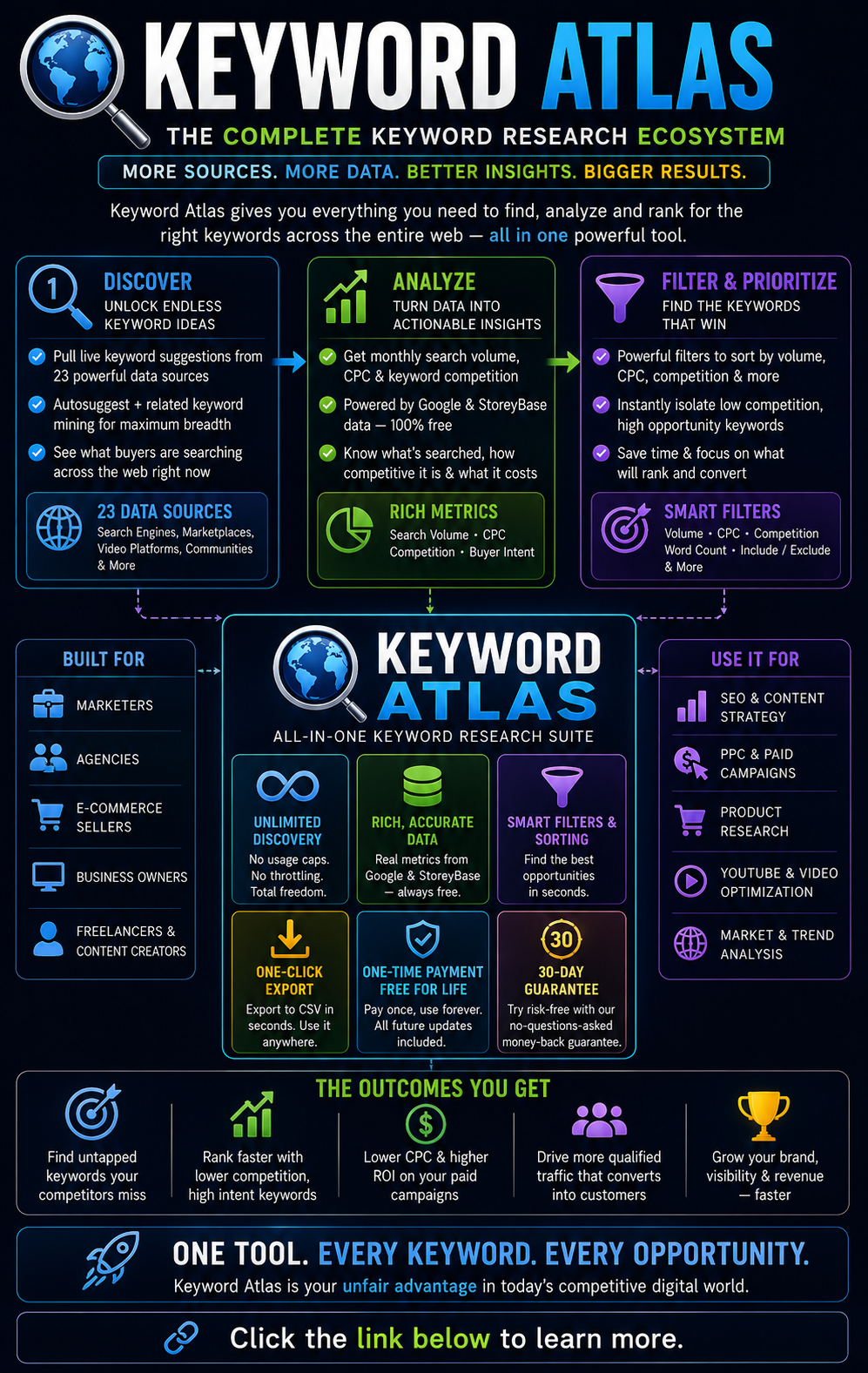
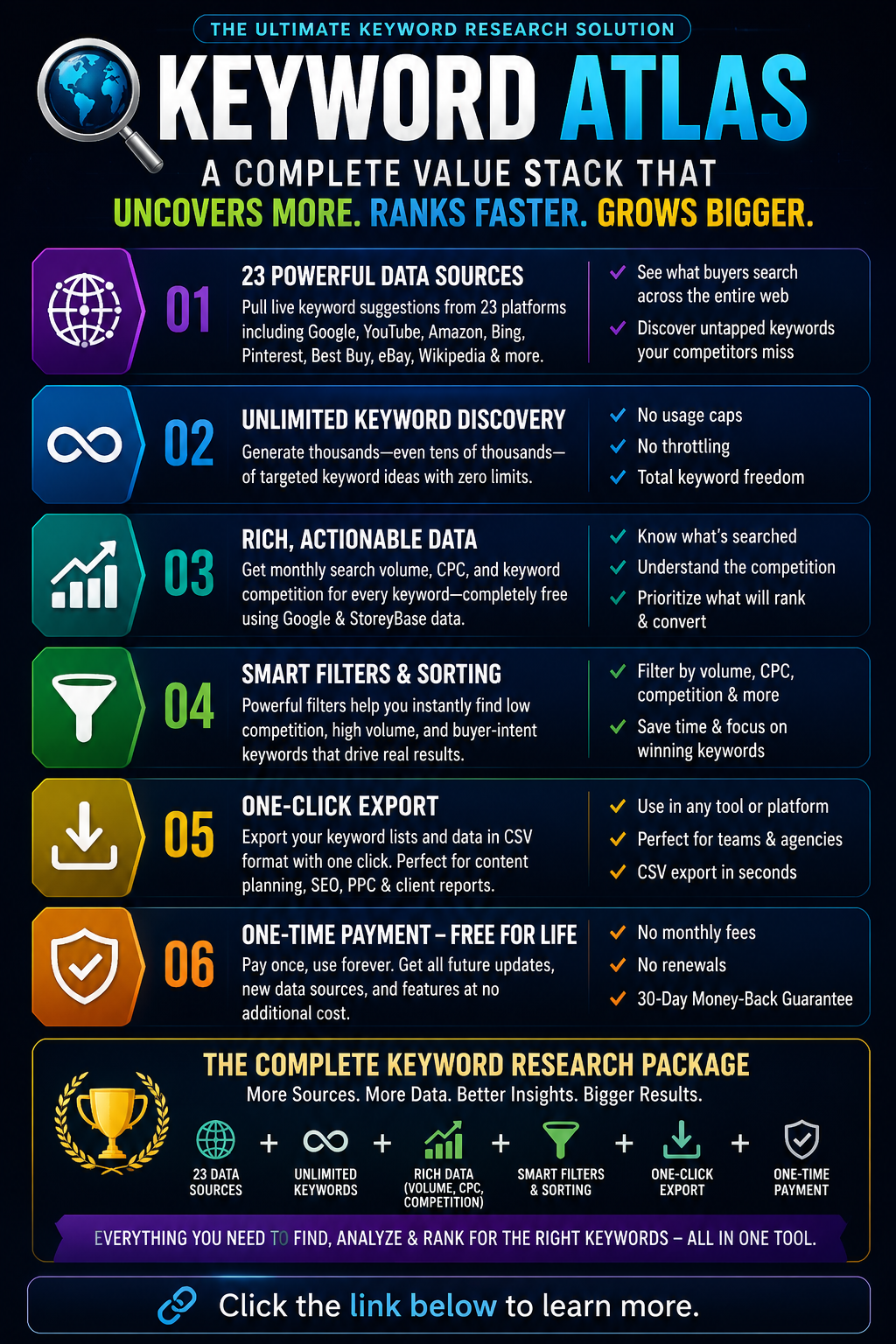
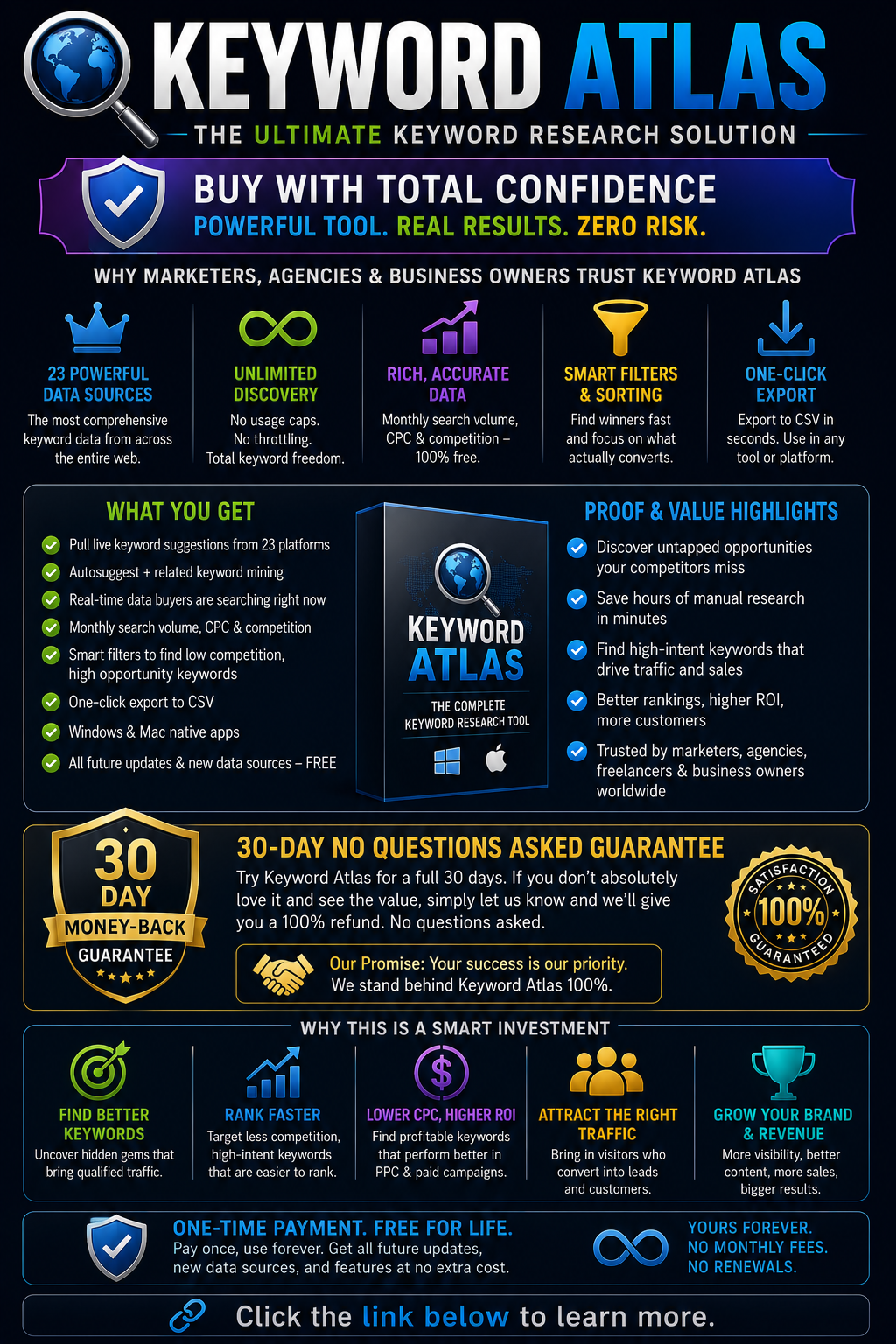
Keyword Atlas was developed as a direct response to these pain points. Instead of sticking to a single-source approach, it sources live keyword data from over 21 different platforms—recent updates boast 23, with the addition of Pinterest and Best Buy. Each source brings with it unique audience insights, trending phrases, and intent-specific search behavior, arming marketers with real opportunities that others routinely miss.
Key Differentiators:
Broad Data Sources: By pulling suggestions and related keywords from search engines (Google, Bing, Yahoo, AOL, and Ask), e-commerce sites (Amazon, Best Buy, and eBay), video/search platforms (YouTube and Google Play Store), and community or shopping destinations (Pinterest and Wikipedia), Keyword Atlas allows users to see the full landscape of buyer intent and viral trends.
Unlimited Volume: Where most tools are throttled based on plan or usage limits, Keyword Atlas has no artificial caps: users routinely generate thousands—even tens of thousands—of targeted keyword combinations per campaign or topic.
Rich Data: Alongside phrases, the tool gathers critical stats (search volume, CPC, keyword competition) at no extra cost by leveraging both Google and StoreyBase, so the keywords delivered aren’t just speculative—they are grounded in real-world, measurable demand.
One-Time Payment Model: Perhaps the most market-disrupting feature is pricing—after the initial license purchase, all future updates, data pulls, and exports are free for life, backed by a 30-day no-questions-asked guarantee.
Cross-Platform Support: Native applications for both Windows and Mac mean the software runs smoothly and securely across virtually any modern computer.
Break Free from Google-Limited Data – Reveal Buyer Intent Across Amazon, YouTube, Pinterest & More
How Keyword Atlas Works: Workflow and Features
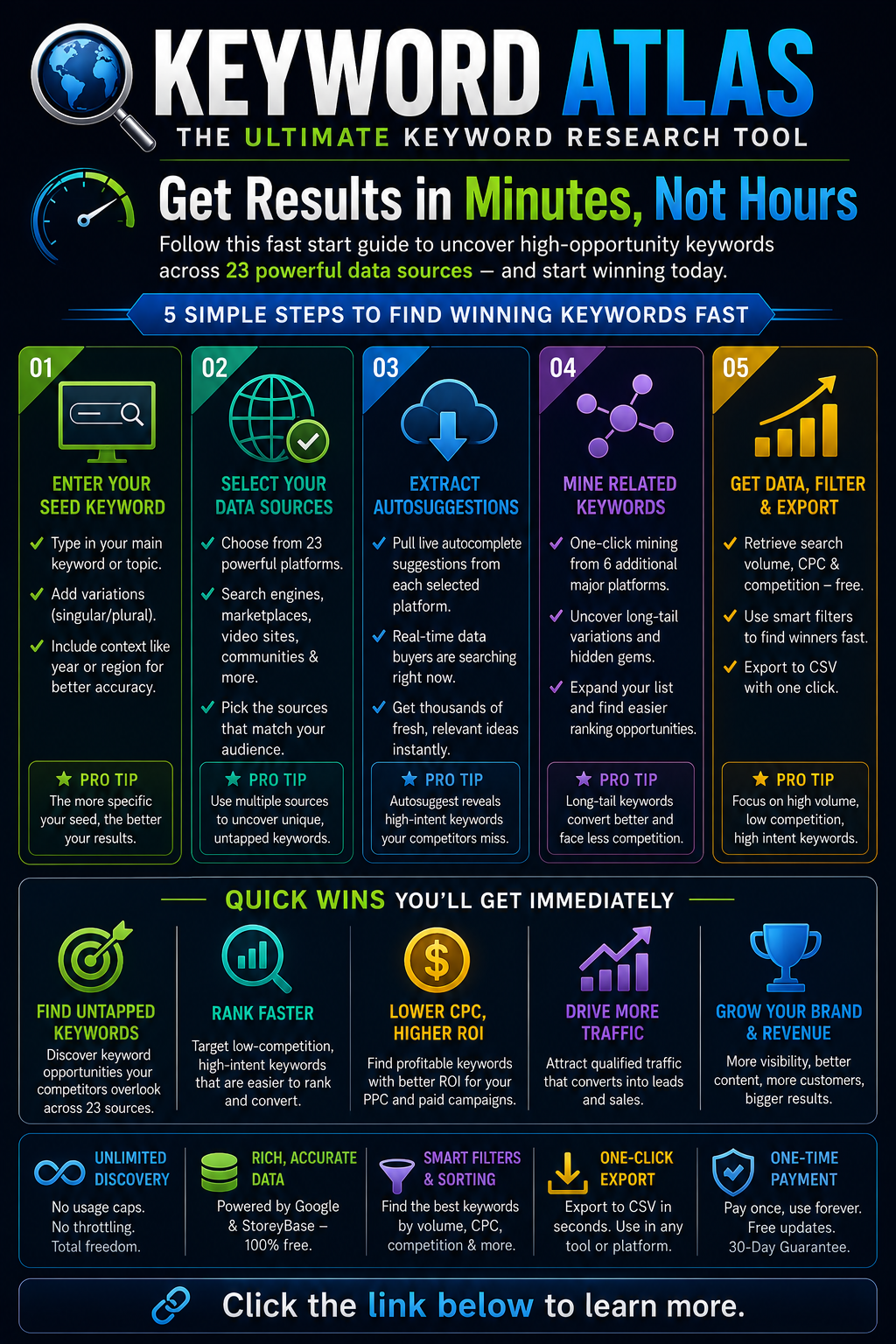
Unlike most keyword research tools that lock users into rigid workflows or confusing dashboards, Keyword Atlas is engineered for both power and ease of use. The process begins like most research: enter a seed keyword (or short list of keywords)—but that’s where the similarities end.
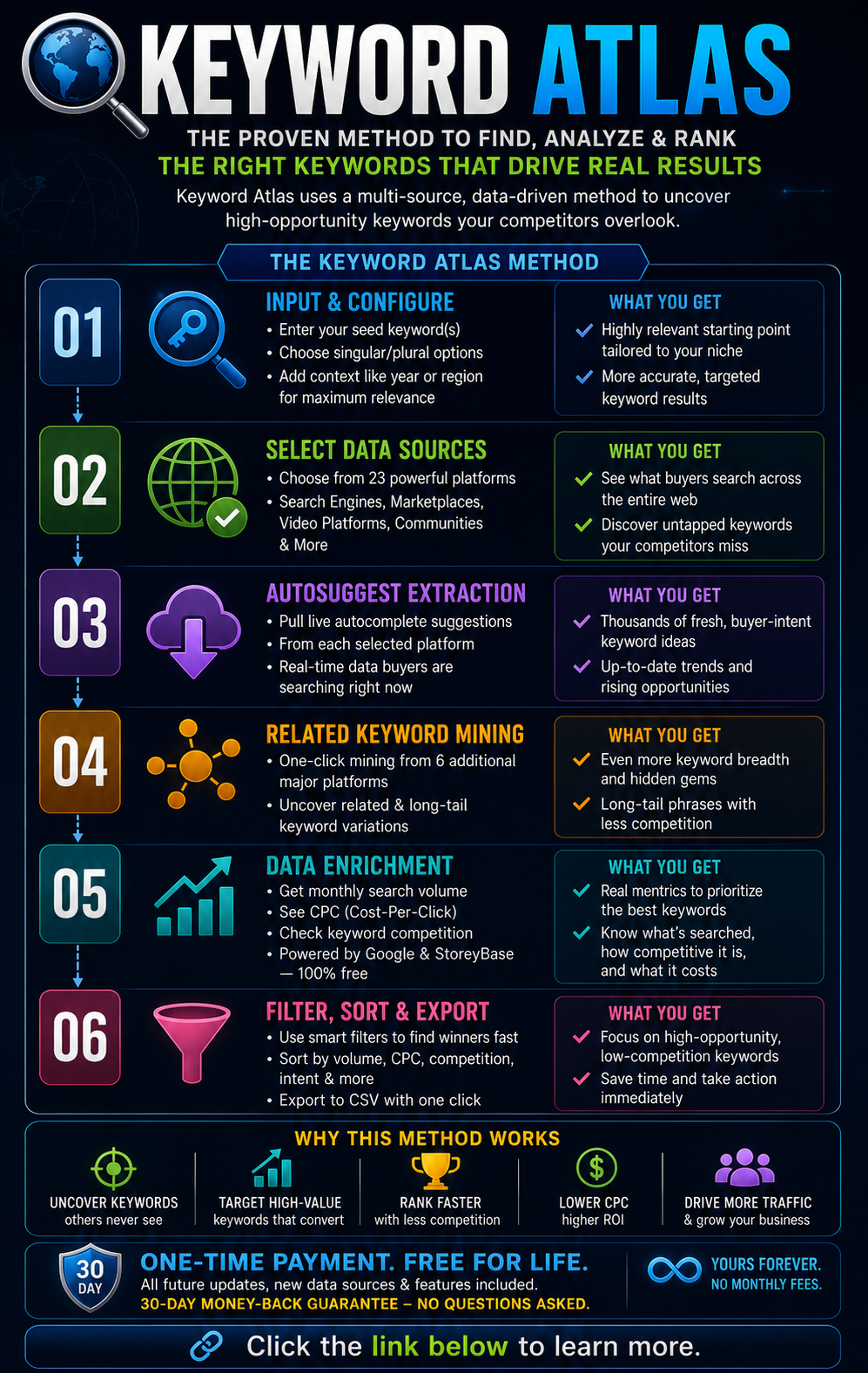
Step-by-Step Walkthrough:
1. Keyword Input:
Enter your main keyword. You can specify variations (singular, plural) and even add context (like current year or region) to guide relevance.
2. Select Data Sources:
Users are presented with the full menu of available sources—from search engines and video platforms to major retailers and community sites. It’s as simple as checking boxes to indicate which avenues to scan.
3. Autosuggest Extraction:
The software connects in real time to each platform’s suggest API, pulling the latest and most organically generated keyword phrases buyers are searching for at that very moment.
4. Related Keyword Mining:
For even greater breadth, a single click lets you mine related phrases from six additional major platforms—a feature especially valuable for surfacing less obvious but still high-volume terms.
5. Data Enrichment:
For each keyword, you can pull free monthly search volume estimates, CPC data, and competitiveness scores from public and bespoke data sources. This is crucial for prioritizing phrases with both reach and a realistic chance of ranking.
6. Filtering and Export:
What use is a mountain of data if you can’t act on it? Keyword Atlas’s quick filters and custom sorting tools let you hone in on exactly what matters—then export campaign-ready sets for Google Ads, SEO campaigns, or content plans, all with one click.
7. Idea Generator:
For those “stuck” moments, the idea generator can produce 100+ phrase templates across 15 categories from a single keyword seed, expanding brainstorms and breaking through creative blocks.
Optimize Ad Spend: Discover Low-Competition, High-Intent Keywords and Lower Your CPC Today
The Real-World Impact: What Results Can You Expect?
No tool is worth the cost if it can’t produce tangible results. Keyword Atlas is trusted by individual marketers, agencies, and entrepreneurs because it bridges the gap between research and outcomes.
Keyword Volume and Diversity: What takes days of manual scraping or crowdsourcing on other platforms gets done in minutes. Many users easily extract 1,000–3,000 keyword variations per product, post, or campaign, unlocking micro-niche opportunities their competitors miss.
Lower Ad Costs (and Higher Conversions): Because the tool uncovers untapped, long-tail phrases with real buyer intent, PPC specialists often report substantial reductions in cost-per-click and increases in click-through rate—directly attributable to targeting overlooked terms.
Faster SEO Gains: By identifying low-competition, high-intent keywords across multiple ecosystems, businesses can publish more targeted content that ranks quicker—often seeing traffic gains in weeks, not months.
Agency and Freelance Revenue: Those on the commercial & outsource plan use Keyword Atlas as the backbone of their services, generating exhaustive keyword research and competitive analysis at scale for clients, all while keeping costs predictable and profits high.
Zero Risk: The 30-day refund policy, responsive support, and verified safe software stack remove all barriers to trial—even skeptical users can test the claims with no risk.
Strategic Insights: Why This Content Works for Cold Traffic
Most traffic arriving at the blog post is cold—these readers typed a problem or question into Google, seeking actionable answers, not product pitches. The blog structure is designed to meet them exactly where they are:
Problem Acknowledgement: The article begins by recognizing the visitor’s pain—not enough quality keyword ideas, too much competition, wasted time and money.
Sympathetic Frustration: It goes deeper by unpacking why common tools fail, framing the need for a new solution without criticizing readers for their past choices. This builds trust quickly.
Valuable Teaching: Educating the reader on the *why* behind multiple data sources establishes both credibility for Keyword Atlas and authority for the content itself. The strategy isn’t “buy this software”; it’s “here’s the smarter way professionals are finding keywords.”
Transparent Recommendation: The post recommends Keyword Atlas as a “shortcut” rather than a magical fix. By revealing how it solves the described problems (and showing the logic), the link to the offer feels natural, not forced.
Proof Over Hype: Results are grounded in attainable, concrete numbers and scenarios, sidestepping overblown claims that might push skeptics away.
Curiosity-Based CTA: Instead of high-pressure selling, the final call to action encourages readers to see what’s “inside”—helping them act out of interest, not obligation.
Test Drive the Idea Generator – Instantly Create 100+ Phrase Templates for Your Niche
SEO and Conversion-Driven Elements
Every aspect of the post is optimized according to best practices:
Keyword Targeting: The primary SEO keyword “best keyword research software” appears in the title, meta, intro, and key subheadings. Secondary keywords are woven throughout, naturally boosting topical relevance.
Featured Snippet Opportunity: Subheading questions (“How does using 21+ keyword sources turbocharge your results?”) are included to target Google’s featured snippet boxes.
FAQ Section: Frequently asked questions address user objections and boost on-page SEO by matching long-tail queries.
Meta Elements and Schema: The post is eligible for the Article and FAQ schema, maximizing chances for rich results and higher organic click-through rates.
Internal and External Links: Recommended related blog topics help with internal linking and topical authority. Credible sources (Moz, Google’s own guides) are cited to anchor trust.
External Sharing: Companion assets—Pinterest pins, email subject lines, and social share captions—extend reach beyond organic search.
Conclusion
Keyword Atlas represents a paradigm shift in keyword research, democratizing powerful, sprawling data for marketers of all levels. Its ability to tap into over 21 live data sources, enrich keywords with valuable stats, and eliminate recurring charges makes it uniquely positioned for today’s competitive, omnichannel digital landscape.
For anyone ready to leave behind guesswork, recurring bills, and the limitations of outdated tools, Keyword Atlas isn’t just another software—it’s a smarter approach to digital growth.
By following a blog strategy that meets readers’ questions head-on, teaches with transparency, and offers a genuine solution, the content doesn’t just rank well—it converts the right visitors into buyers.
Whether you’re an agency, a solopreneur, or an in-house marketer, there’s never been a better time—or tool—to unlock the hidden potential in your keyword research.
