
The promise of easy money and online prosperity remains one of the most enduring temptations on the internet. ProfitBot AI markets itself as an artificial intelligence-powered tool capable of generating impressive profits—up to $697 per day—supposedly requiring minimal effort, experience, or investment. However, a close examination reveals that not only is ProfitBot AI extremely unlikely to deliver on these promises, but it also bears all the hallmarks of a classic online scam and deceptive get-rich-quick scheme. This summary explores the characteristics, claims, and tactics that reveal ProfitBot AI as a blatant scam, designed to exploit the hopes of unsuspecting individuals seeking financial independence.
Warning: Proceed At Your Own Risk
1. Extravagant Claims of Effortless Wealth
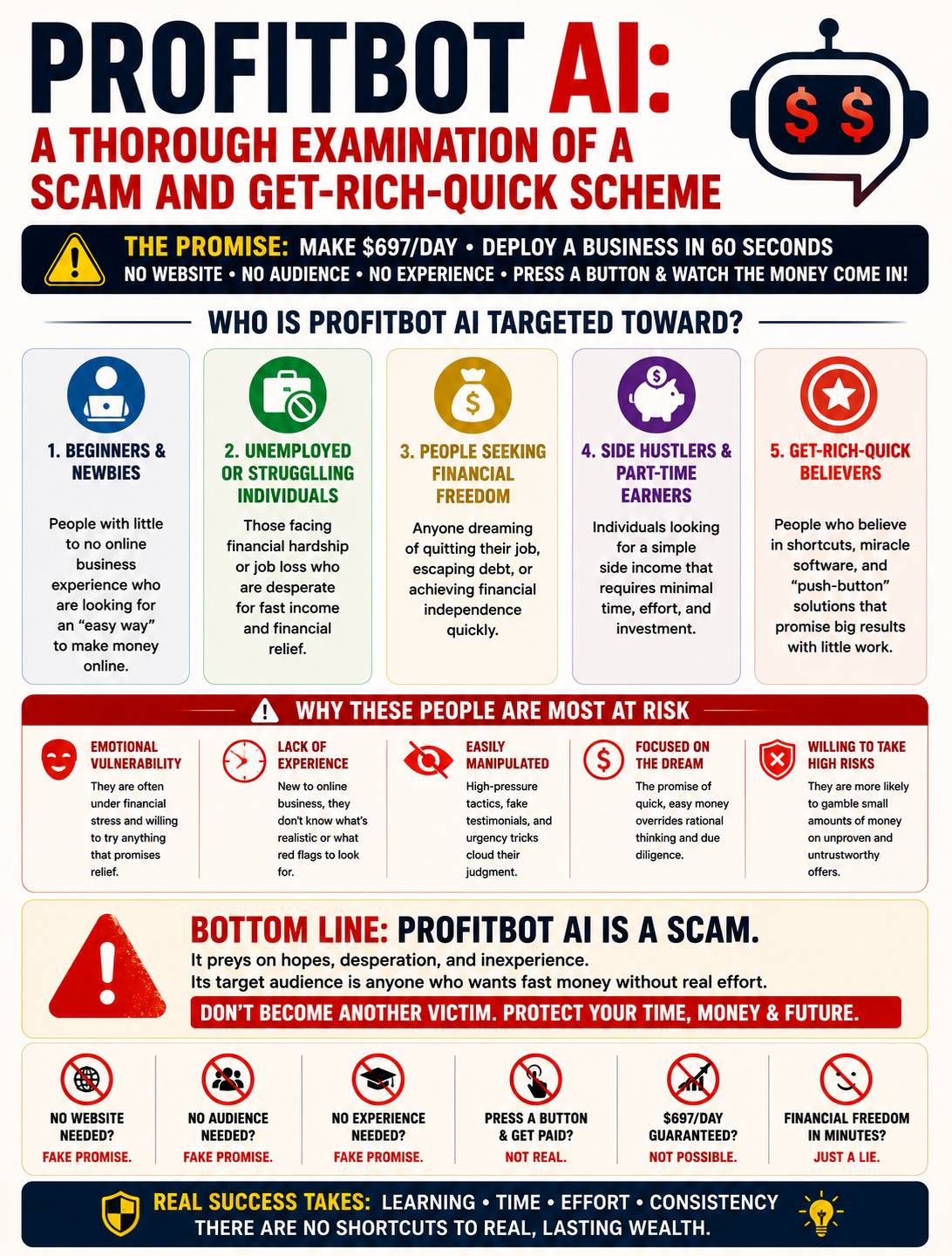
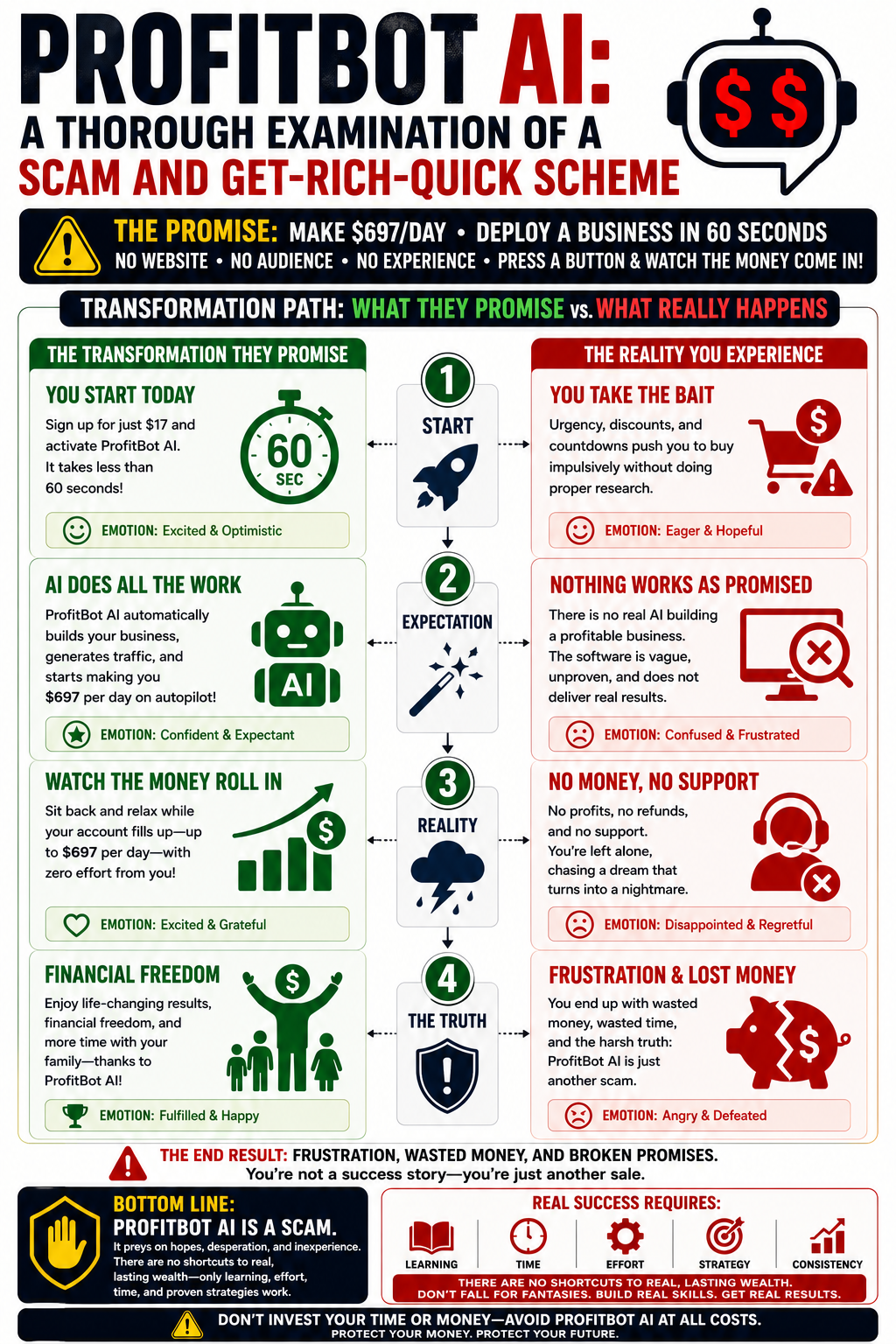
A core sign of a scam is the reliance on sensational promises. ProfitBot AI does not disappoint in this respect, making repeated, outlandish assertions about its earning potential. Phrases such as “make $697/day” and “deploy a business in 60 seconds” are repeated throughout its marketing material. To compound the illusion, the offer claims you don’t need a website, an existing audience, or even basic selling skills—you simply sign up, press a button, and “watch the money come in.”
Such guarantees are fundamentally disconnected from the realities of business. Legitimate income generation, online or offline, always demands time, effort, learning, and adaptation. No real-world company or software, regardless of its technology, can ethically promise substantial passive income in exchange for a negligible investment of $17 and no required skillset.
These promises are not only misleading; they prey on the hopes of financially vulnerable individuals and those with limited experience in digital business, luring them into spending money with false expectations.
Warning: Proceed At Your Own Risk
2. Manipulation Through Emotional and Urgency Tactics
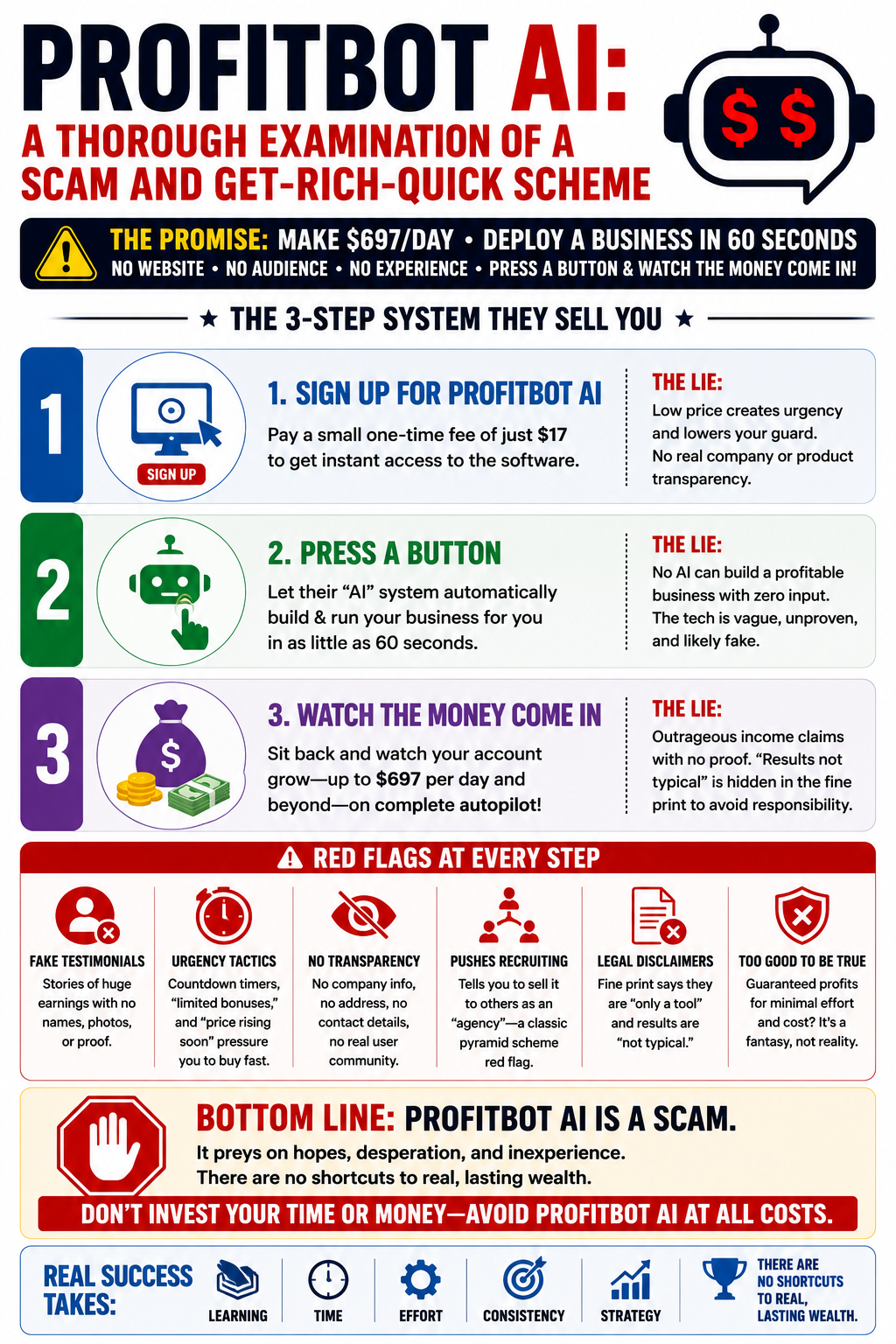
ProfitBot AI leverages psychological manipulation to an extreme degree. Its sales pages and advertisements use urgent calls to action: “Hurry! Price rises soon!” and “First 50 buyers get a special bonus!” are common refrains. Multiple “Buy Now!” buttons are scattered across the promotional material, often accompanied by countdown timers and “limited availability” notices, all designed to create artificial scarcity.
These tactics serve one purpose: to pressure users into a hasty decision, bypassing rational scrutiny. By making buyers believe they will miss out on an exclusive opportunity, ProfitBot AI’s creators increase the likelihood that an individual makes a purchase without sufficient due diligence or skepticism. This psychological lever is a primary instrument in the scam artist’s toolkit—real, trustworthy businesses do not require such high-pressure sales approaches.
3. Unverifiable, Fabricated Success Stories
One of the more insidious elements of the ProfitBot AI scheme is the abundance of glowing, yet unverifiable, testimonials and “success” stories. The website is littered with anecdotal evidence—claims of users making $12,000 in seven days, stories about families achieving life-changing results, and countless five-star reviews. However, no contact information, verifiable proof, or even last names accompany these statements.
This is a classic setup for fraud: by fostering a sense of peer validation (“look at all these other people making money!”), ProfitBot AI attempts to lower the defenses of potential buyers. In reality, there is no evidence that these users exist, let alone that they have realized the earnings described. The absence of documentary proof or any means of authenticating these testimonials should serve as an immediate red flag. In reputable software markets, user reviews are typically tied to traceable, verifiable sources—none of which are present here.
4. Misleading and Vague Use of ‘AI’
The term “AI” is thrown about with abandon but without substance. The technical underpinnings of the ProfitBot AI software are left deliberately vague. There is no demonstration of the technology, no access to code, user manuals, or transparent disclosure of how the backend functions. Instead, the material suggests that the AI component can autonomously create businesses, generate profits, and require zero intervention from the user.
Such assertions defy not only commercial practice but basic common sense. No AI technology today—or in the foreseeable future—can automate the multifaceted, highly complex work of building a profitable enterprise with the mere press of a button and absolutely no user input. Serious AI companies showcase their technology and provide demos, white papers, and opportunities for third-party validation. In contrast, ProfitBot AI relies on mystique and opacity. It counts on buyers not questioning the fantasy of a “fully running AI business” that makes guaranteed profits for everyone.
Warning: Proceed At Your Own Risk
5. Selling the Dream, Not an Actual Product
A tell-tale sign of a scam is when promotional material focuses almost entirely on the dream of wealth, with scant attention paid to the actual product or service. ProfitBot AI’s sales page is almost exclusively dedicated to reiterating how much money buyers will supposedly make after purchasing their tool. Explanations of the technology or its operation, if they exist at all, are vague, buzzword-laden, and unsubstantiated.
There’s a complete absence of transparency about what the software actually does, what problems it solves, or how it operates. Instead, the user is inundated with visions of their imminent riches and testimonials of success. In genuine business or tech ventures, clarity about the product—its features, capabilities, limitations, and intended use—is foregrounded. With ProfitBot AI, the opposite is true: the “dream” is the product, and it is sold at the expense of the truth.
6. Lack of Transparency, Company Info, and Community
Legitimate businesses are transparent about who they are, where they operate, and how they can be contacted. ProfitBot AI, on the other hand, provides no verifiable company address, no evidence of business registration, and no actual contact details. Critically, web searches yield no reputable third-party reviews, news articles, or coverage by the business/software press. There is also no trace of a genuine user community, which would exist if the product delivered on its lofty claims.
The absence of these fundamentals is not merely an oversight; it’s an indicator that the people behind ProfitBot AI do not wish their identities or business operations to be scrutinized. This opacity shields them from accountability, making it all but impossible for victims to seek recourse if (or more realistically, when) they are defrauded.
7. Classic Scam Hallmarks and Marketing Tricks
Certain lines and tactics are almost universal in online scams, and ProfitBot AI deploys them liberally. For example, the “original” price of $497 per month is immediately slashed to a one-time fee of $17—a markdown so steep and implausible that it only serves to create a false sense of value and urgency. Other classics include promises of “No Monthly Fees,” “No Hidden Costs,” and a “30 Day Money Back Guarantee!”—all phrases designed to lower buyer resistance and play on trust but frequently meaningless if the seller is untraceable or nonresponsive.
A particularly alarming aspect is the suggestion that buyers can make money selling ProfitBot AI to others “as an agency”—this is a thinly veiled, classic pyramid scheme tactic. If the main way one can earn money from a product is by recruiting new buyers rather than by actually using the product to perform a valuable service, it crosses the line from scam to outright illegal pyramid operation in many jurisdictions.
8. Small Print Denies Responsibility
Hidden deep in the FAQ or terms and conditions is a legal disclaimer stating “results not typical” and clarifying that ProfitBot AI is “only a software tool.” This is a textbook legal move used by scam operators to dodge responsibility for failing to deliver on their claims. While this technically protects the scammer from prosecution, it exposes their intent to deceive—they are well aware that none of their advertised results can be proven or expected by the vast majority (if any) of buyers.
No responsible company would promise miraculous earnings on one hand and then disavow all guarantees of success in the fine print. This juxtaposition between headline claims and concealed legal disclaimers is always a major warning sign.
Warning: Proceed At Your Own Risk
Conclusion: A Textbook Case of the Online Scam/“Get–Rich–Quick” Scheme
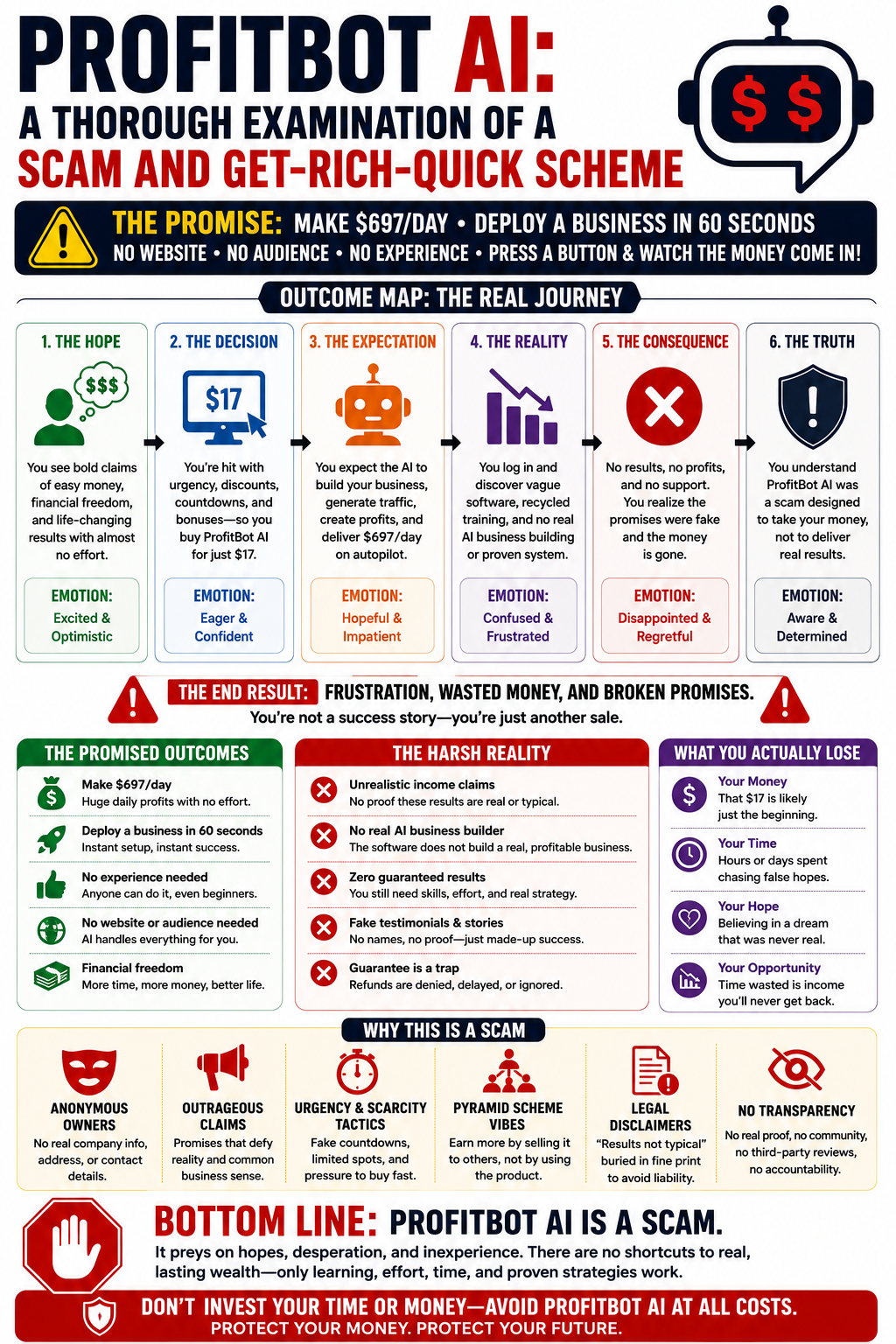
Every facet of ProfitBot AI’s offering—from its impossible claims and fabricated testimonials to its lack of transparency and legal disclaimers—signals extreme caution. The evidence is overwhelming: this operation is not designed to help users generate real income. Rather, its entire business model is to convince as many unsuspecting buyers as possible to hand over their money by selling a fantasy.
Historically, schemes promising automated, passive income for trivial effort and cost have routinely left thousands of victims defrauded and disillusioned. There is no shortcut to financial security; genuine online or AI-driven businesses require learning, effort, adaptation, and time. No real product can guarantee specific, high profits for a tiny fee and zero input.
For those seeking to build legitimate online businesses or leverage real AI technology, ProfitBot AI is everything to avoid: it’s a scam in both spirit and execution, and it preys on the very individuals it purports to help.
Bottom Line: Don’t invest time or money into ProfitBot AI. It’s a classic scam, designed only to separate you from your money, delivering worthless products and broken promises.
